Paper Bag Strength Testing: What Bulk Buyers Should Know
KD & Co.


Connect With KD & Co. For Reliable Paper Bag & Packaging Solutions Today.
Shed No. 3, Plot No. 4, CMS Compound, Anangpur Village, Faridabad, India - 121003
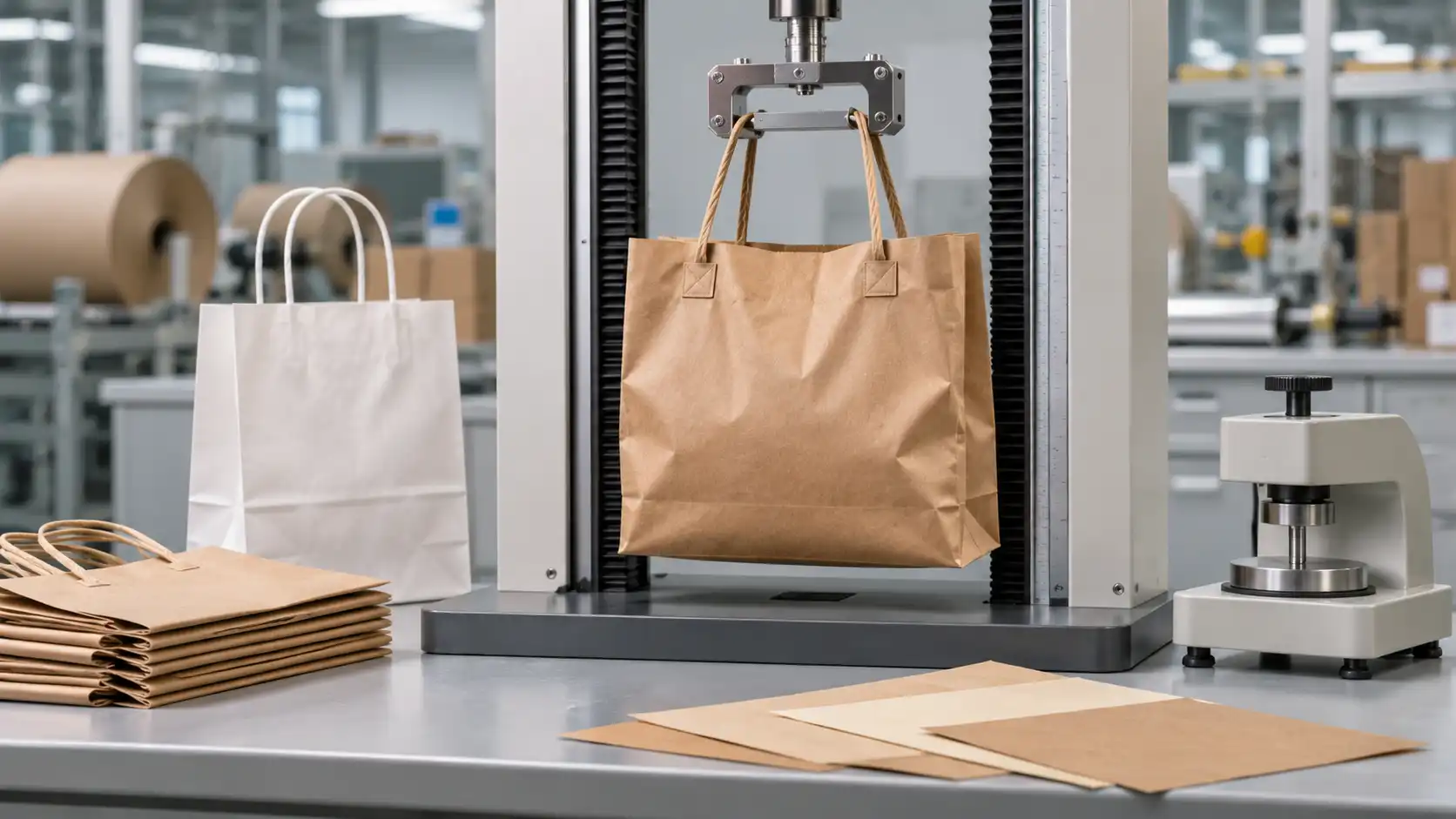
A packet that's perfect on the shelf can fall apart at the curb. The handle rips. The bottom gives way. Products drop and damage your reputation. If you order bulk paper bags, it can happen to a whole lot of them all at once. This guide to paper bag strength testing explains the tests worth doing.
Weak bags cost more than the bag itself. A split bottom damages products and can get a shipment rejected. Here's what buyers miss: paper strength isn't bag strength. Paper bag quality testing catches weak seams and loose handles early. Skipping it leads to:
The seven tests include both the base paper and the converted bag. Always consult your supplier on all of them before you accept any sample. Skip none.
GSM means grams per square metre. It shows paper weight, not bag strength. A 100 GSM sheet won't beat an 80 GSM one if the grade is weak, because kraft paper strength depends on fibre quality too. Ask first:
Tensile strength shows how much pull paper takes before breaking. Tear resistance shows how it holds once a nick starts. Labs commonly follow ISO 1924-2 for tensile and ISO 1974 for tear. Read any number against the load the bag will carry. Ask for:
Handles fail more often than paper does. Twisted paper rope handles work well when anchored properly, and KD & Co. makes its rope handles in-house. Paper bag handle strength still depends on how the patch holds. Look at:
The base takes the full weight. Uneven folds or patchy glue open it under load. Paper bag construction must stay consistent, because one good sample means little if the next thousand vary. Bottom strength depends on all of these:
Load testing counts most. The bag will then be filled with the actual product or test weights and lifted to see if there is any stretching or deformity in any part, particularly around the handles. Paper bag load capacity needs written terms:
Did you know? “Paper may become weak after coming into contact with water, even though from the outside it appears perfect. This is why storage is important for bulk paper bags.”
Customers don't carry a bag once. They lift, set down, swing and carry again, and a static weight test can't copy that. Paper bag durability needs repeated handling, plus a drop test where it suits your product. A simple routine:
Moisture is absorbed into the paper, which then weakens. The adhesive will soften also. Even before a bag has been delivered to a customer, a damp godown causes undisclosed damage so the lifetime of a kraft paper bag durability relies on storage as much as it does producing the bag. Do these:
Use this paper bag quality checklist when you request samples. KD & Co. sends a sample before production, so you can run these checks first. Get these in writing:
Most failures trace back to a few repeat paper bag buying mistakes. Each is cheap to fix before the order and expensive after. Watch out for:
Did You Know? “The GSM number only denotes the weight of the material and not its strength in terms of the bag. On occasions, a low GSM bag performs better than a high GSM bag.”
Different businesses have varying needs when it comes to their bags. The weight carried in a boutique and supermarket will not be the same, and therefore one requirement will not be appropriate for both.
You should choose a bag depending on the type of product to be placed in it:
Plenty of paper bag manufacturers in India will send a sample. Fewer agree specifications in writing or keep records batch after batch. Ask about print quality, order quantities and delivery dates too. KD & Co. produces bags in its own unit, from printing to handle fitting, so one team answers for the whole job. A bulk paper bag manufacturer should offer that accountability.
Test the whole bag, not just the paper. The handles, seams, loading, and storing are all responsible for the performance of the paper bags. It is important that the checklist be used and that written specifications be obtained. To discuss strength requirements and bulk quantities, talk to KD & Co..
Not really. Besides the GSM value, there are other determinants such as fiber quality, stitching, attachment of the handle, and even the size of the paper bags that make the bags strong. A good quality 80 GSM bag may outperform a poor quality 100 GSM bag.
A sample bag should be filled with the consumer’s goods or the test weight agreed upon by both parties. The consumer should lift the bag and hold it for a specified period. The bag should then be tested for any tearing or bulging.
Inspect the size, quality of paper used, type of handles, bottom stitching or other finishing work. Then load-test the sample using the agreed load. Keep the sample with your signature. In future, match production units to the sample as the first batch usually has the best-quality samples.
Load the bag and test the handle by pulling on it. The weakest part that tears should be the rope, glue or paper used in the handle construction. A good handle will remain intact and spread the load over the bag body.
Yes. The moisture will make the paper fibers soft as well as glue, making the strength weak. So it is important to store the boxes above the ground level, away from moist walls, and seal the bags till usage. If you have humid conditions, test a few samples under the same first.
KD & Co. provides 80 and 100 GSM of Kraft paper bags. Choose 80 GSM for lighter retail products and 100 GSM for heavier loads. Natural, bleached and virgin Kraft are provided. Let us know about your product weight first.
Tell us your size, GSM, quantity and other requirements. Our team will help you take the order from specification to dispatch.